





A camper, boat, or equipment trailer puts several demands on a truck at once. Chevy Colorado towing capacity starts with the rated trailer limit, but that number needs context. Payload, tongue weight, passengers, cargo, and truck configuration all enter the math. Therefore, a trailer below 7,700 pounds does not automatically fit every Colorado. The exact truck and loaded trailer must remain inside every published weight rating. This guide explains how those numbers connect before the hitch meets the trailer.
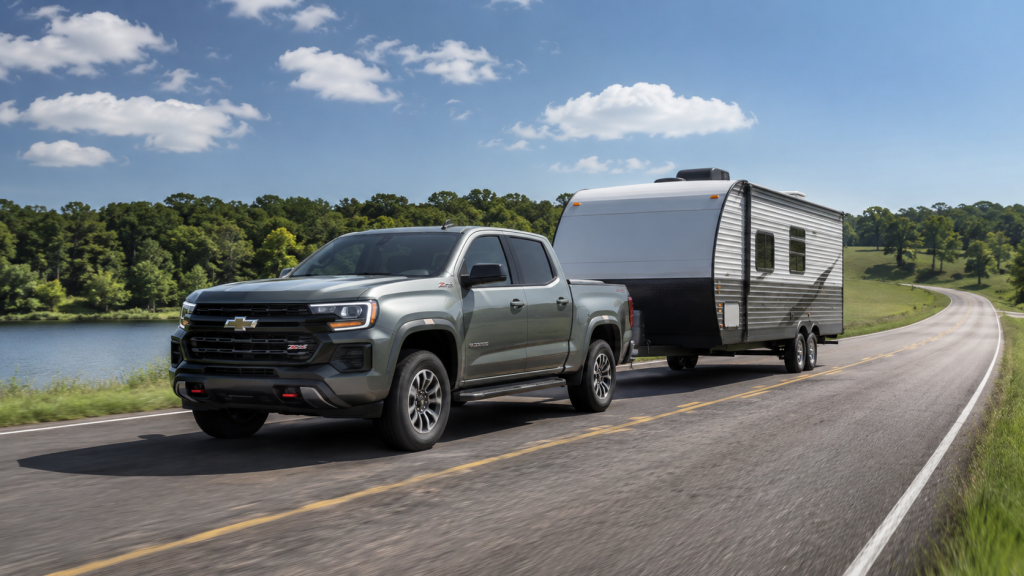
What Chevy Colorado Towing Capacity Measures
How much can a Chevy Colorado tow? The rating describes the heaviest trailer approved for a specific truck setup. Chevrolet lists a 7,700 pound maximum available towing rating for the 2026 Colorado. However, that figure represents a properly equipped truck, not every Colorado on the road.
Chevrolet uses several weight ratings when establishing towing limits. Gross Combination Weight Rating covers the loaded truck and loaded trailer together. Gross Vehicle Weight Rating covers the truck, occupants, cargo, and trailer tongue weight. Rear Gross Axle Weight Rating limits the weight carried by the rear axle.
Therefore, one published towing number cannot replace the other ratings. A loaded trailer must fit beneath the trailer rating and the combined rating. The truck must also remain beneath its vehicle and axle limits.
Chevy Colorado towing capacity also changes with the exact truck setup. Chevrolet notes that passengers, cargo, equipment, and accessories reduce remaining trailer weight. For this reason, the label and Owner’s Manual for the specific truck deserve the final check.
Payload and Tongue Weight Share the Same Space
Additionally, payload answers a different question than trailer weight. It measures how much weight the truck itself can carry. Chevrolet lists up to 1,710 pounds of maximum available payload for the 2026 Colorado. Still, that number changes with equipment and configuration.
Moreover, trailer tongue weight presses downward on the hitch. That downward force counts toward the weight carried by the truck. Chevrolet recommends 10 to 15 percent tongue weight for conventional trailers in its 2026 trailering guide.
For this reason, consider a loaded conventional trailer weighing 6,000 pounds. A 10 percent tongue load equals 600 pounds at the hitch. A 15 percent tongue load equals 900 pounds. Therefore, the hitch load can consume a large share of available payload before people enter the cab.
Before towing, account for each load carried by the truck:
- Passenger weight uses part of the available payload before trailer tongue weight enters the calculation.
- Bed cargo adds more weight to the truck and leaves less room beneath its vehicle rating.
- Accessories can add weight before camping gear, tools, coolers, or other cargo enters the bed.
Chevy Colorado towing capacity makes more sense when payload enters the same calculation. Moreover, use loaded trailer weight instead of an empty trailer figure. Water, propane, tools, food, and gear can raise trailer weight before departure.
Why Trailering Equipment Changes the Rating
Why does trailering equipment matter when the engine remains the same? The truck needs the correct hardware to connect, control, and monitor a trailer. Chevrolet ties the Colorado’s 7,700 pound maximum rating to the proper factory equipment.
Additionally, the Advanced Trailering Package adds hardware and technology for trailer operation on qualifying Colorado configurations. Chevrolet also offers Hitch View to show the receiver area during hookup. Therefore, these features address more than engine output.
The towing setup should match the trailer and the truck rating:
- The receiver and hitch hardware must match the trailer weight and connection type.
- Trailer wiring connects required lighting and electrical functions between the truck and trailer.
- Trailer brake equipment coordinates braking support when the trailer requires its own brakes.
Chevy Colorado towing capacity also depends on using equipment approved for the truck and trailer. In addition, Chevrolet advises owners to review the Owner’s Manual before trailering. The manual identifies requirements for the exact truck and trailer combination.
Beyond that, hardware matters because towing places load on braking, cooling, suspension, tires, and chassis components. Consequently, engine torque only answers part of the towing question. The complete truck setup establishes the published limit.
Why Colorado Trim and Configuration Matter
Why can two Chevy Colorados carry different towing ratings? Their engines may match while chassis hardware, tires, suspension, and installed equipment differ. Those changes alter vehicle weight and the ratings assigned to each configuration.
In addition, the 2026 Colorado uses a 2.7 liter TurboMax engine with 310 horsepower and 430 pound feet of torque. However, Chevrolet offers five distinct Colorado models with different hardware and missions. WT, LT, Trail Boss, Z71, and ZR2 do not share identical chassis setups.
For a towing focused truck, compare the exact configuration before comparing trim names. Check the factory trailering equipment, payload label, axle ratings, tires, and trailer connection. Therefore, a trim with more specialized trail hardware may carry a different trailer rating.
Chevy Colorado towing capacity should never come from the trim badge alone. Instead, use the rating assigned to the truck being considered. This matters when a camper or equipment trailer will travel with people and bed cargo.
Moreover, off road hardware can also change the equation. Larger tires, suspension changes, added chassis equipment, and vehicle weight all enter the engineering limits. For this reason, compare the complete truck specification against the loaded trailer.
When Silverado Enters the Towing Conversation
Colorado gives Chevrolet truck shoppers a midsize option with up to 7,700 pounds of maximum available towing. However, some trailer plans call for more room within the published ratings. Silverado 1500 reaches up to 13,300 pounds of maximum available towing for 2026.
Still, that larger rating does not mean every trailer requires a Silverado. Instead, start with the loaded trailer, tongue weight, passengers, and truck cargo. Then compare those numbers with the ratings for the exact Colorado.
Chevy Colorado towing capacity may fit a boat, utility trailer, or travel trailer while leaving enough room within every rating. By contrast, heavier campers or larger equipment trailers may point toward Silverado 1500. Silverado HD enters the discussion when trailer demands move well beyond half ton truck ratings.
Furthermore, towing frequency deserves attention during truck selection. A trailer used several weekends each year presents a different task from frequent heavy towing. Route grades, cargo changes, and trailer loading also deserve careful review before choosing the truck.
Vince’s GM Center offers Colorado, Silverado 1500, and Silverado HD models for Chevrolet truck shoppers in Burlington. Still, the towing decision should begin with weight, not truck size alone. Bring the trailer specifications and expected cargo into that comparison. Then verify the exact truck rating before you tow.
Connect with us

